Choosing a career program can feel overwhelming. With so many options available, it is easy to focus only on salary, job demand, or program length. However, one of the most important factors is often overlooked: your personality.
Understanding how to match your personality to the right career program can help you choose a path that feels natural, enjoyable, and sustainable in the long term. When your personality aligns with your work, you are more likely to stay motivated, perform well, and grow in your career.
This guide explains how personality affects career choices, how to identify your strengths, and how to connect those traits to the right programs and industries.
Why Personality Matters in Career Choice
Your personality shapes how you:
- Communicate with others
- Solve problems
- Handle stress
- Work in teams or independently
- Stay motivated
When there is a mismatch between your personality and your career, work can feel stressful and exhausting. When there is a good match, work feels more natural and rewarding.
Example
A highly social person may feel unhappy in a job with little interaction, while a detail-oriented person may struggle in a fast, unpredictable role.
This is why learning how to match your personality to the right career program is so valuable.
Understanding Personality Types
You do not need a complex test to begin understanding your personality. Simple observations about your behaviour and preferences can help.
Common Personality Traits
- Introvert vs extrovert
- Creative vs analytical
- Structured vs flexible
- Independent vs team-oriented
- Detail-focused vs big-picture thinker
Each trait can point you toward specific career paths.
Popular Career Personality Frameworks
Many career advisors use frameworks like Holland Codes or personality groupings to match people with careers.
Simplified Career Personality Types
| Personality Type | Traits | Suitable Careers |
| Social | Friendly, helpful | Healthcare, customer service |
| Investigative | Analytical, curious | IT, data science |
| Artistic | Creative, expressive | Design, marketing |
| Conventional | Organized, detail-focused | Accounting, administration |
| Enterprising | Confident, persuasive | Sales, business |
| Realistic | Practical, hands-on | Technical roles |
These categories help simplify the process of choosing a career path.
Step by Step Guide to Matching Your Personality
Learning how to match your personality to the right career program becomes easier when you follow clear steps.
Step 1: Identify Your Strengths
Start by asking yourself:
- What tasks do I enjoy
- What do people often compliment me on
- Do I prefer working with people, data, or tools
- Do I like routine or variety
Write down your answers to see patterns.
Step 2: Understand Your Work Style
Think about how you prefer to work.
- Do you enjoy teamwork or working alone
- Do you like structured schedules or flexibility
- Do you prefer creative tasks or logical tasks
Your work style is a strong indicator of suitable careers.
Step 3: Match Traits to Career Fields
Once you understand your personality, connect it to industries.
| Personality Trait | Matching Field |
| Social and helpful | Healthcare, customer service |
| Analytical | IT, data science |
| Creative | Web design, marketing |
| Organized | Business administration, accounting |
| Technical | Software development, IT support |
Step 4: Choose the Right Career Program
Programs should build skills that match your personality and career goals.
Institutions like Academy of Learning Career College, North York offer a wide range of career-focused programs designed for different personality types and learning styles.
Matching Personality to Career Programs
Let’s explore how different personalities align with specific program areas.
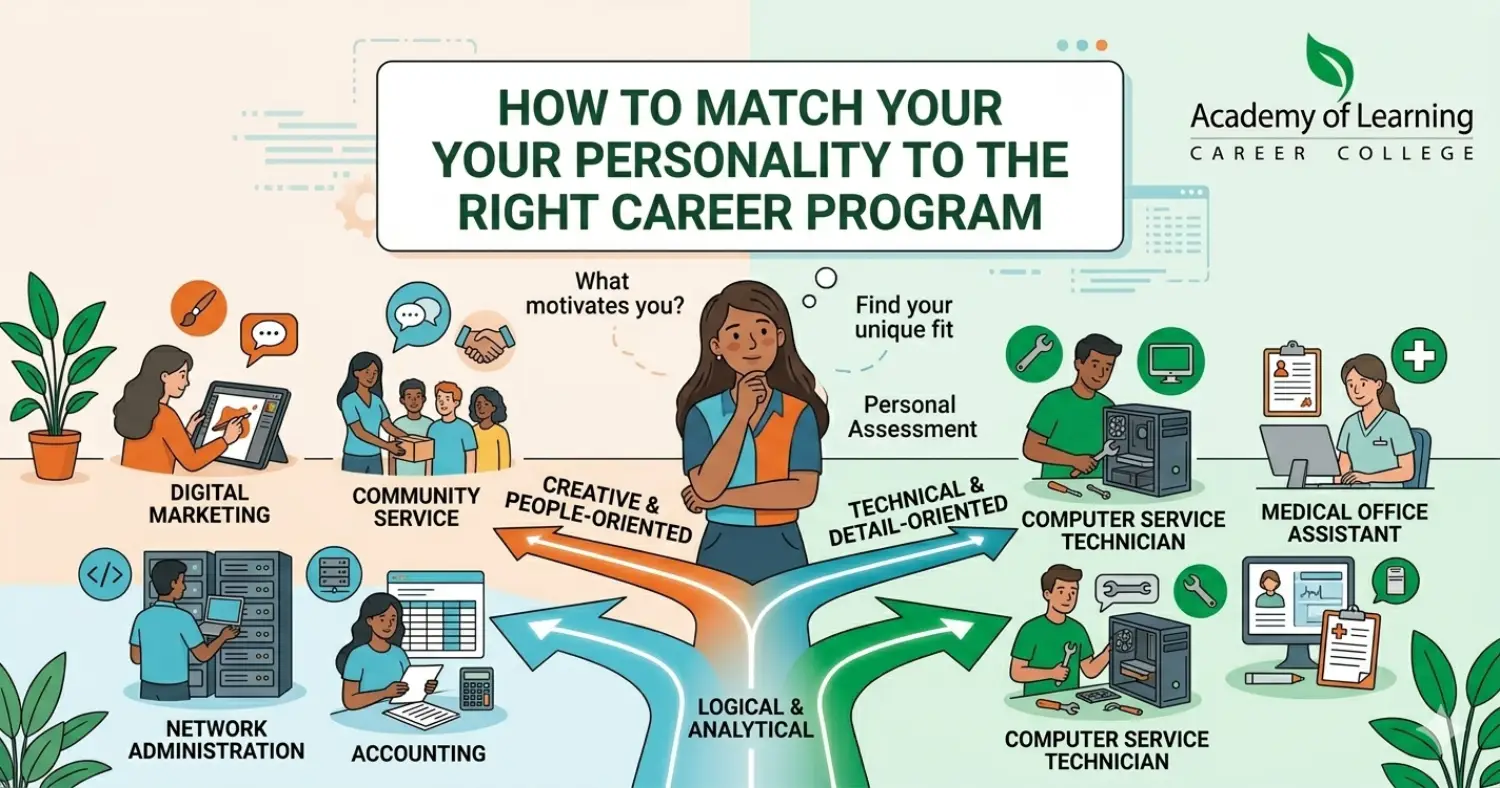
1. Social and People-Oriented Personalities
If you enjoy helping others and working with people, consider:
- Healthcare programs
- Medical Office Assistant
- Customer service roles
- Community services
These careers involve communication, empathy, and teamwork.
2. Analytical and Problem-Solving Personalities
If you enjoy logic and solving problems:
- IT Support Specialist
- Data Science
- Network Administration
- Software Development
These roles require technical thinking and structured problem-solving.
3. Creative Personalities
If you enjoy design and creativity:
- Web Design
- Marketing
- Graphic design
- Content creation
These programs allow you to express ideas visually and creatively.
4. Organized and Detail-Oriented Personalities
If you prefer structure and organization:
- Accounting and payroll
- Business administration
- Office administration
These roles involve planning, accuracy, and system management.
5. Leadership and Business-Oriented Personalities
If you enjoy leading and decision-making:
- Business administration
- Project management
- Sales and marketing
These roles require confidence, communication, and strategic thinking.
Benefits of Matching Personality to Career Programs
Understanding how to match your personality to the right career program offers several advantages.
Better Job Satisfaction
You are more likely to enjoy your work when it matches your personality.
Higher Performance
People perform better in roles that fit their strengths.
Career Growth
You are more motivated to learn and improve in the right environment.
Reduced Stress
Work feels less overwhelming when it aligns with your natural style.
Real World Example
Consider two students:
Student A chooses a career based only on salary. They enter a highly technical role but struggle because they prefer working with people.
Student B chooses a career that matches their personality. They enjoy communication and choose healthcare administration. They feel more confident and succeed in their role.
This example shows why personality matters.
Common Mistakes to Avoid
When choosing a career program, avoid these mistakes:
- Choosing based only on salary
- Ignoring your interests
- Following others’ choices
- Not researching the program
- Underestimating your strengths
Taking time to understand yourself leads to better decisions.
How Career Programs Support Different Learning Styles
Modern career programs are designed to support different personalities and learning styles.
Features of Career-Focused Programs
- Hands-on training
- Flexible learning options
- Practical skills development
- Support from instructors
- Real-world simulations
These features help students succeed regardless of their background.
Quick Personality to Career Match Guide
| Personality | Best Career Program |
| Social | Healthcare, customer service |
| Analytical | IT, data science |
| Creative | Web design, marketing |
| Organized | Accounting, administration |
| Leadership | Business, management |
Final Thoughts
Choosing a career is one of the most important decisions you will make. Understanding how to match your personality to the right career program can help you build a future that feels both successful and fulfilling.
Instead of focusing only on trends or salary, take time to understand your strengths, preferences, and goals. The right program will not only prepare you for a job but also help you grow in a career that suits who you are.
FAQs
-
How to match your personality to the right career program?
Start by identifying your strengths, work style, and interests, then choose a program that aligns with those traits.
-
Why is personality important in career choice?
Personality affects how you work, communicate, and solve problems, making it key to job satisfaction and success.
-
Can personality change over time?
Yes. While core traits stay similar, skills and preferences can develop with experience.
-
What are the best careers for introverts?
Careers in IT, accounting, and data analysis are often suitable for introverts.
-
What are the best careers for extroverts?
Healthcare, sales, and customer service roles are often ideal for extroverts.
-
How do I know which career suits me?
Look at your strengths, interests, and preferred work style, then research matching programs.
-
Should I choose a career based on salary?
Salary is important, but it should not be the only factor when choosing a career.
-
Are career tests helpful?
Yes. Career assessments can provide guidance, but personal reflection is equally important.
-
Can I switch careers later?
Yes. Many people change careers and choose new programs based on updated goals.
-
Do career colleges help with career selection?
Yes. Many career colleges offer guidance and support to help students choose suitable programs.
-
What if I am unsure about my personality?
Start with simple questions about your interests and preferences, and explore different options gradually.
-
Is it better to choose practical programs?
Practical programs can help you gain job-ready skills quickly and enter the workforce faster.